FilaForms
Best Laravel and Filament Form Builders in 2026: 10 Tested
Best Laravel and Filament Form Builders in 2026: 10 Tested

The phrase “Laravel form builder” hides three different products: code-defined component libraries, installable public-form systems, and standalone form applications. Choosing the wrong layer is how teams end up either rebuilding submissions, notifications, and spam protection—or adopting a platform when a small PHP schema would have been enough.
This comparison was checked on August 11, 2026. FilaForms is our product, so its commercial relationship is disclosed here and its claims are held to the same primary-source standard as every other option.
The shortlist
| Product | Type | Current stack signal | License / price | Best fit |
|---|---|---|---|---|
| FilaForms | Filament public-form suite | Filament 4/5; current line uses Filament 5 | Commercial, from $99 | Teams wanting visual editing inside their Laravel app |
| Lara Zeus Bolt | Filament public-form plugin | v5 line for Filament 5 | MIT | Established open-source Filament lifecycle |
| Tapp Form Builder | Filament public-form plugin | Laravel 12/13, Filament 4/5 | MIT | Panel, guest, and tenant-aware form flows |
| afsakar Form Builder | Filament form and email suite | Filament 4/5 | Commercial, $50 | Form plus email-campaign workflows |
| OpnForm | Standalone form application | Laravel/Nuxt application | AGPL core; proprietary Enterprise | A separate self-hosted or managed form service |
| Madbox Form Builder | Embeddable Filament plugin | Laravel 11–13, Filament 4/5 | MIT | Direct URL, iframe, and JavaScript embedding |
| ArtisanPack Forms | Livewire public-form suite | Laravel 11–13, Livewire 3/4 | GPL-3.0-or-later | Non-Filament Livewire applications |
| HyderKamran Form Builder | Laravel visual builder | Composer declares Illuminate 8–12 | MIT | Broad features when compatibility is verified first |
| OG Web Solutions Builder | Laravel visual builder | Broad framework constraint | MIT | Smaller custom Laravel integrations |
| Dcode Form Builder | Laravel + Vue schema package | Laravel 11–13 | MIT | Teams wanting to own a new Vue-based implementation |
“Not documented” is not the same as “does not exist.” Version, price, and feature claims below come from each package’s current repository, Packagist record, documentation, or marketplace listing.
First choose the product layer
1. Code-defined UI libraries
Filament Forms, kris/laravel-form-builder, and similar packages help developers describe inputs, layouts, and validation in code. They do not automatically provide public publishing, a generic submission store, exports, analytics, or notification management.
Choose this layer when the form maps directly to a domain model, developers own every change, and the workflow is specific to the application. Our manual Filament contact-form tutorial shows the work clearly.
2. Installable public-form systems
FilaForms, Bolt, Tapp, afsakar, Madbox, and ArtisanPack add a lifecycle around input components: stored definitions, public rendering, submissions, and some mix of notifications, exports, spam controls, analytics, or tenancy.
Choose this layer when non-developers need to publish forms, or when the same infrastructure would otherwise be rebuilt for every campaign and client.
3. Standalone form applications
OpnForm runs as its own product rather than as a feature inside the host Laravel application. That can create a clean operational boundary, but it also means a separate deployment, database, authentication model, and integration surface.
Ten current options
FilaForms
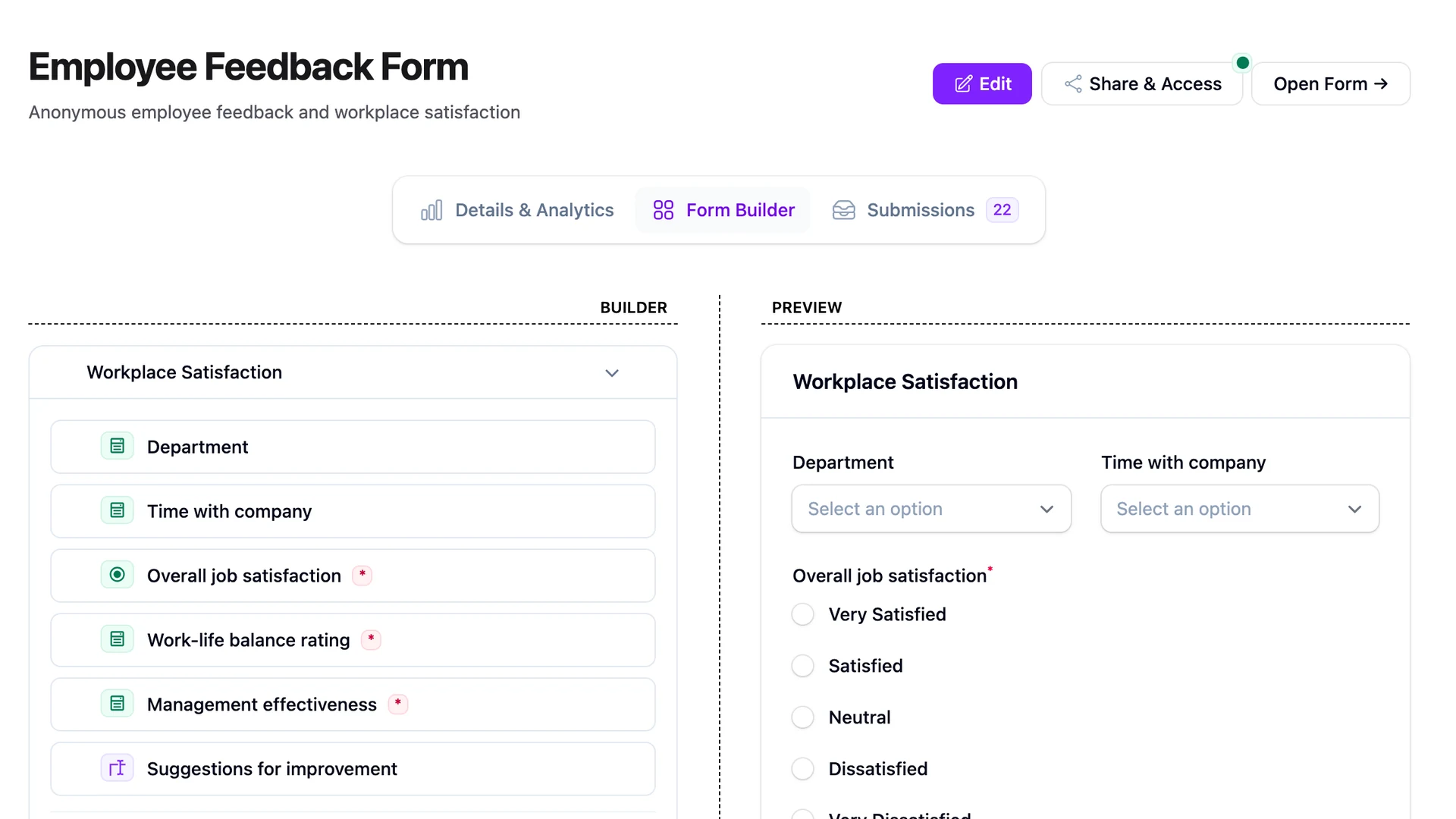
FilaForms is a commercial Filament-native suite for public forms. It offers drag-and-drop editing, 25+ field types, conditional logic, multi-step forms, submissions, analytics, notifications, exports, public URLs, and embedding. Its defining trade-off is that the data and UI remain inside the host Laravel application, while the package owns the reusable form lifecycle.
It is the strongest fit when a team already uses Filament and wants administrators or clients to edit forms without deployments. It is unnecessary when one stable form should map directly to a bespoke aggregate. See the architecture decisions behind FilaForms and the current pricing.
Source: FilaForms on the Filament marketplace.
Lara Zeus Bolt
Bolt is a mature MIT-licensed Filament option with public scaffolding, wizard and tab layouts, conditional visibility, responses, email notifications, reports, statistics, widgets, events, and extension points. Its v5 line targets Filament 5 and brings several Lara Zeus dependencies.
Bolt is a strong free choice when its opinionated package family fits the application. Test the complete dependency set and upgrade path rather than evaluating the headline package alone.
Sources: Bolt on Packagist and Bolt v5 documentation.
Tapp Filament Form Builder
Tapp documents admin, guest, and authenticated front-end panel plugins, validation, entry management, CSV export, events, and multi-tenancy. Its July 2026 release supports recent Laravel and Filament lines.
It is attractive when different panel contexts matter. Because its README and Packagist distribution notes have not always matched, validate installation in a clean pinned application before committing.
Source: Tapp on Packagist.
afsakar Form Builder
afsakar is a commercial plugin, not an open-source entry. Its scope combines a visual form builder and public/panel rendering with a block email builder, bulk sends, tracking, and analytics widgets.
That broader email focus may be valuable for campaign-heavy applications, but it is a different product shape from a form-centric submission platform.
Source: afsakar on the Filament marketplace.
OpnForm
OpnForm is an open-core standalone application with a no-code builder, embeds, logic, CAPTCHA, notifications, integrations, and analytics. The core is AGPL-3.0; Enterprise features use proprietary terms.
Choose it when forms should be their own service. Review the AGPL implications with counsel if you modify and operate the network application, and include the extra operational boundary in the decision.
Sources: OpnForm repository and OpnForm plans.
Madbox Form Builder
Madbox is a young MIT Filament plugin with full-page, iframe, and one-line JavaScript embedding, submissions, email actions, and a tenant model. Its explicit cross-site embedding options are its clearest differentiator.
The trade-off is maturity: the current 0.x release and smaller documented field set deserve a clean-app test and a careful upgrade policy.
Source: Madbox on Packagist.
ArtisanPack Forms
ArtisanPack is a Livewire system rather than a Filament plugin. It documents 20+ fields, a visual builder, conditional logic, multi-step flows, private uploads, HMAC webhooks, spam controls, retention, and notifications.
It is the most relevant option here for a Livewire application that does not use Filament. Teams must be comfortable with GPL-3.0-or-later and the surrounding ArtisanPack package ecosystem.
Source: ArtisanPack Forms on Packagist.
HyderKamran Laravel Form Builder
HyderKamran documents 21 fields, drag-and-drop editing, repeaters, conditional logic, exports, notifications, webhooks, an API, and iframe/Blade embedding. The important caveat is compatibility: its README emphasizes Laravel 10/11 while Composer metadata permits Illuminate through 12, not 13.
Treat that mismatch as a test requirement, not proof of either compatibility or incompatibility.
Source: HyderKamran on Packagist.
OG Web Solutions Laravel Form Builder
This MIT package covers drag-and-drop construction, validation, submissions, CAPTCHA, CSV, and Blade rendering. Its very broad laravel/framework >=5.0 constraint does not prove modern-version correctness.
It can suit a smaller custom integration, but Laravel 13 teams should test migrations, dependency resolution, browser behavior, and maintenance activity before adoption.
Source: OG Web Solutions on Packagist.
Dcode Group Laravel Form Builder
Dcode is a new MIT Laravel-and-Vue package for JSON definitions, rendering, validation helpers, and attached form data. It supports current Laravel lines but is early in its lifecycle and requires both Composer and NPM integration.
It is best viewed as a foundation for teams that want to own the surrounding lifecycle, not as a drop-in replacement for a mature submission platform.
Source: Dcode Group on Packagist.
A practical decision matrix
| Need | Start with |
|---|---|
| One stable form mapped to application models | Direct Filament Forms or Livewire |
| Visual editing inside an existing Filament app | FilaForms, Bolt, Tapp, afsakar, or Madbox |
| Free, established Filament lifecycle | Bolt |
| Cross-site embed formats | Madbox or a standalone product |
| Livewire without Filament | ArtisanPack |
| Separate form service | OpnForm |
| Maximum bespoke workflow control | A code-defined form or smaller schema package |
How to test before choosing
Install each finalist into a clean application pinned to the versions you deploy. Build the same eight-field form, render it anonymously, submit valid and invalid data, double-click submit, upload a file, inspect storage visibility, export responses, and exercise email or webhook behavior. Record package versions, install time, errors, screenshots, and uninstall steps.
This matters more than feature-checkbox counts. A package can document a capability while making assumptions that conflict with your tenant model, queue topology, storage policy, or frontend build.
The durable choice is the smallest layer that owns the lifecycle you actually need. If you are still deciding whether to buy that lifecycle or build it, use our build-versus-buy task list.